|
| HOME | SHIPS | RAIDERS | SUBMARINES | CASUALTIES | CALENDAR | ABOUT |
|---|
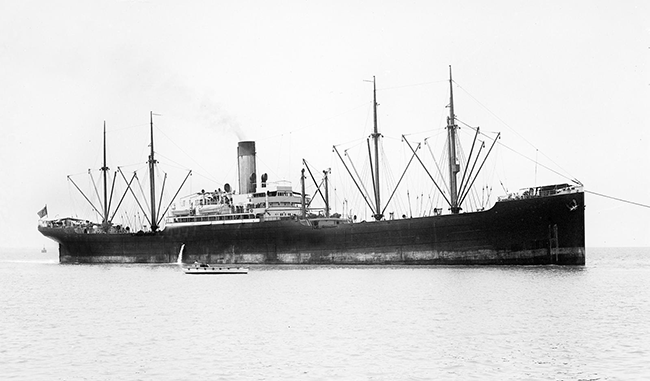 |
ss Cambridge Federal Steam Navigation Company Ltd
Built in Germany as Vogtland for the Hamburg America Line, launched on 9 December 1916 but the war delayed her completion. UK government supplied the vessel to Federal Steam as a war reparation. Completed in 1920. length 524.5 ft, beam 65.7 ft and depth was 37.3 ft , 11,066GRT Twin screws, each driven by a triple expansion engine. Between them her twin engines were rated at 1,106 NHP, giving her a speed of 14 knots |
|
SS Cambridge was a refrigerated steam cargo liner of the Federal Steam Navigation Company. Federal Steam operated a cargo liner service between New Zealand, Australia and the UK, bringing refrigerated produce to the UK and general cargo to Australia and New Zealand. With the declaration of the Second World War Cambridge continued her regular trade between New Zealand, Australia and the UK. She sailed mostly unescorted. She used both the Cape of Good Hope route via South Africa and the trans-Pacific route via the Panama Canal. On 9 September 1940 she left Milford Haven,under war charter to the British government, with Convoy OB 211. She called at Cape Town on 9th October, Adelaide on 2nd November and Melbourne on 5th November. She sailed from Melbourne, Sydney bound, on the 7th of November. At 2300 hrs on the 7th when aproximately 3.7nm SE of Wilsons Promontory she struck one of the mines that had been laid by the German auxiliary cruiser Passat. The mine struck the after end of the ship, there was a large explosion and she began to settle by the stern. An attempt to send out a distress signal on the wireless failed because the dynamos had been damaged in the explosion, the emergency wireless set was then used used to send her distress signal. As the ship was settling quickly, Captain A.J. Paddy Angell , ordered the crew to muster and abandon ship. Three of Cambridge's lifeboats were launched. J. Kinnear, Ships Carpenter, returned to his cabin to retrieve personal possessions and perished, the only fatality of the incident. Cambridge went down by the stern, in 45 minutes. Captain Angell later described the Cambridge as "it sank under the waves and disappeared leaving only a great spout of water and steam rising into the sky, then settling down into a bubbling patch of sea". The crew then spent an anxious night floating around in a minefield - they knew land was not far away as they could see the South East Point lighthouse, but were additionally worried about drifting further out to sea. The auxiliary minesweeper HMAS Orara rescued the occupants of the three lifeboats and took them to Port Welshpool. Bass Strait was closed to shipping and the HMAS Orara and another minesweeper the HMAS Durraween commenced sweeping off the Promontory on the 9th of November, and eventually 43 mines from the Bass Strait fields were detonated or rendered safe after being washed ashore. Cambridge was the first Allied vessel to be lost by enemy action in Australian waters in the Second World War. The wreck of the Cambridge was located on 21st of May 1988 by the National Safety Council vessel M.V. Blue Nabila using side scan sonar. It lies upright on a sandy bottom at a depth of 67 metres, in an intact condition at position Latitude: -39.16 , Longitude: 146.5 . |
||